Introduction
This is a framework I built to understand myself. It may not be a universal theory. But I wanted it to explain what existing frameworks — Maslow's hierarchy of needs, self-determination theory — leave unexplained.
Core Premise: Desire Is Abstracted Survival Instinct
First, a distinction.
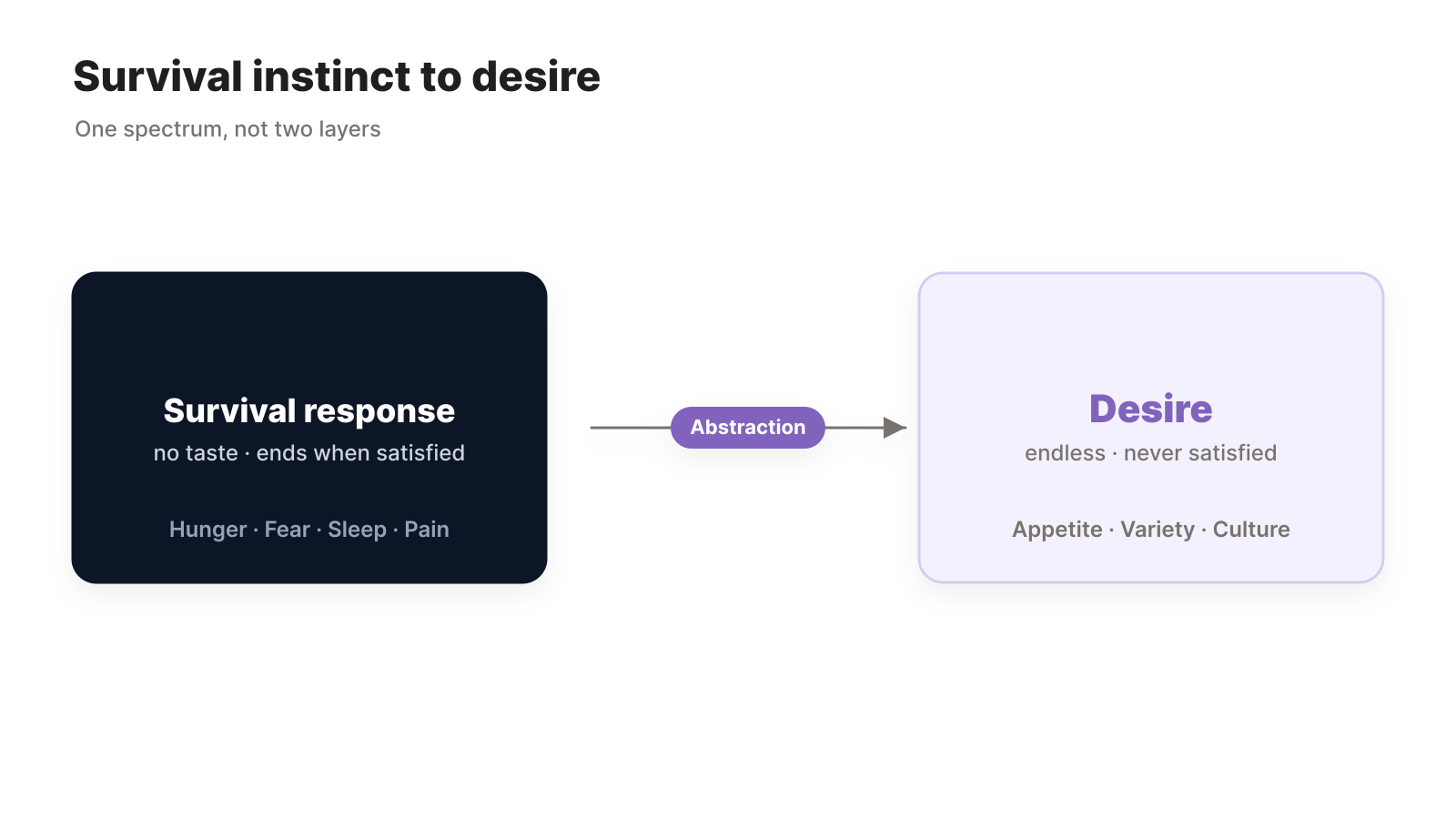
Survival responses have no taste. Hunger, fear, the drive to sleep, pain — these simply operate. They end when satisfied. Some people fear snakes and others fear heights, but no one wants to feel fear.
Desires are different. Their tastes diverge endlessly. Even after satisfaction, you want more. Take appetite — hunger is a survival response, but wanting to eat something more delicious is a desire. An entire food culture grows out of that gap.
Desire is a survival instinct abstracted so far that its original form becomes hard to recognize. The two are not separate layers but a spectrum.
The Four Desires
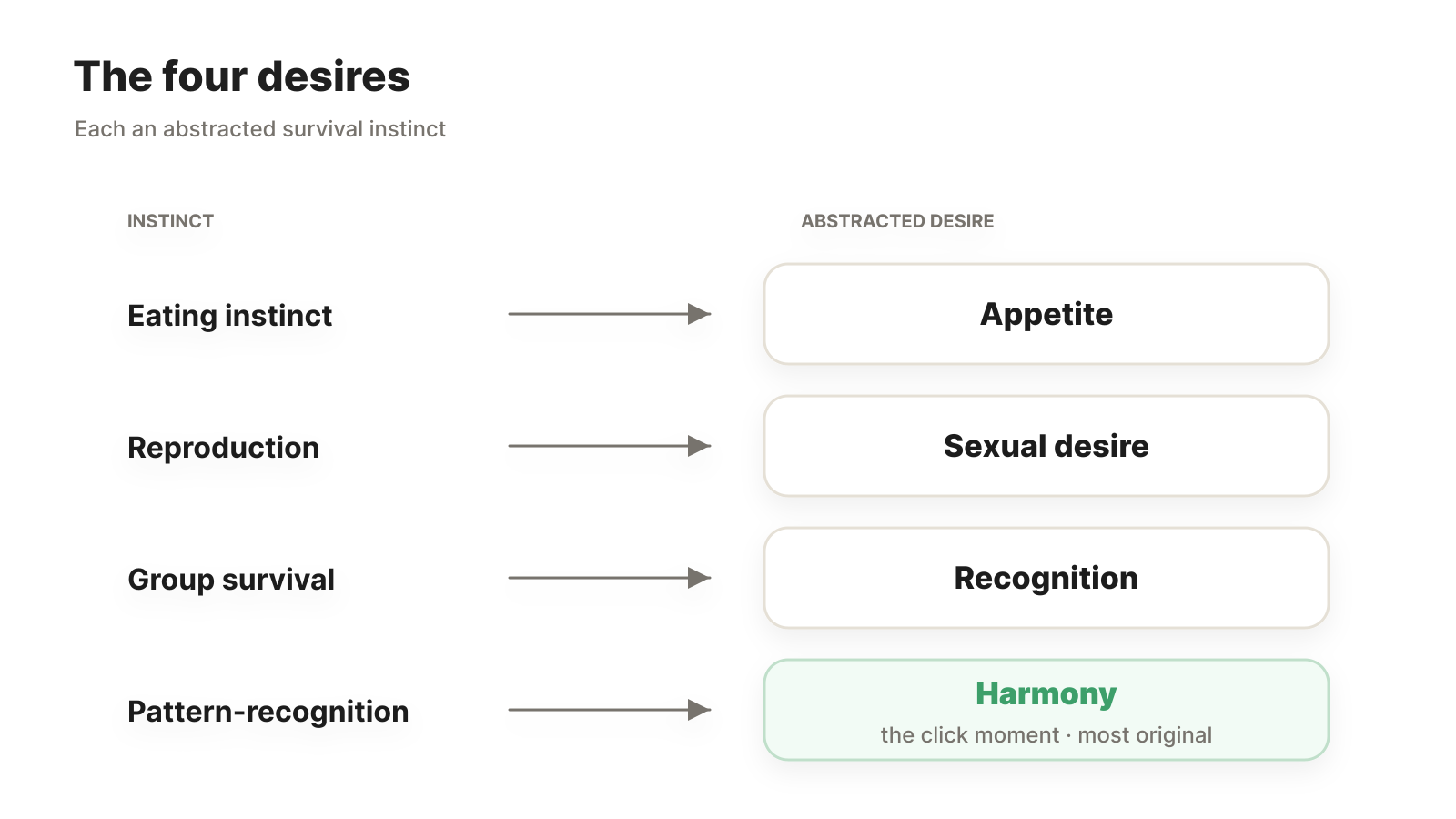
1. Appetite
An abstraction of the eating instinct. Distinct from hunger.
2. Sexual Desire
An abstraction of the reproductive instinct. It differentiates into intimacy, attraction, and relationships.
3. Recognition Desire
An abstraction of the group-survival instinct. In modern society, and especially among high achievers, it is the most dominant desire. Achievement, status, honor, being chosen by others — all of it comes from here.
4. Harmony Desire
An abstraction of the pattern-recognition instinct. This is the most original concept in the framework.
Definition: the desire to pursue, or to accidentally encounter, the moment when something 'clicks' into place.
It is size-independent. When a physics equation resolves cleanly, when a rhythm-game note lands on the beat, when an ASMR sound feels exactly right — it is all the same sensation. Too small to call awe, too specific to reduce to pleasure. Just a quiet "오오오" or "딱" (click).
Harmony desire lives at the intersection of flow, awe, and aesthetic experience — but no existing framework treats that intersection as its own unit of desire.
Pathological States
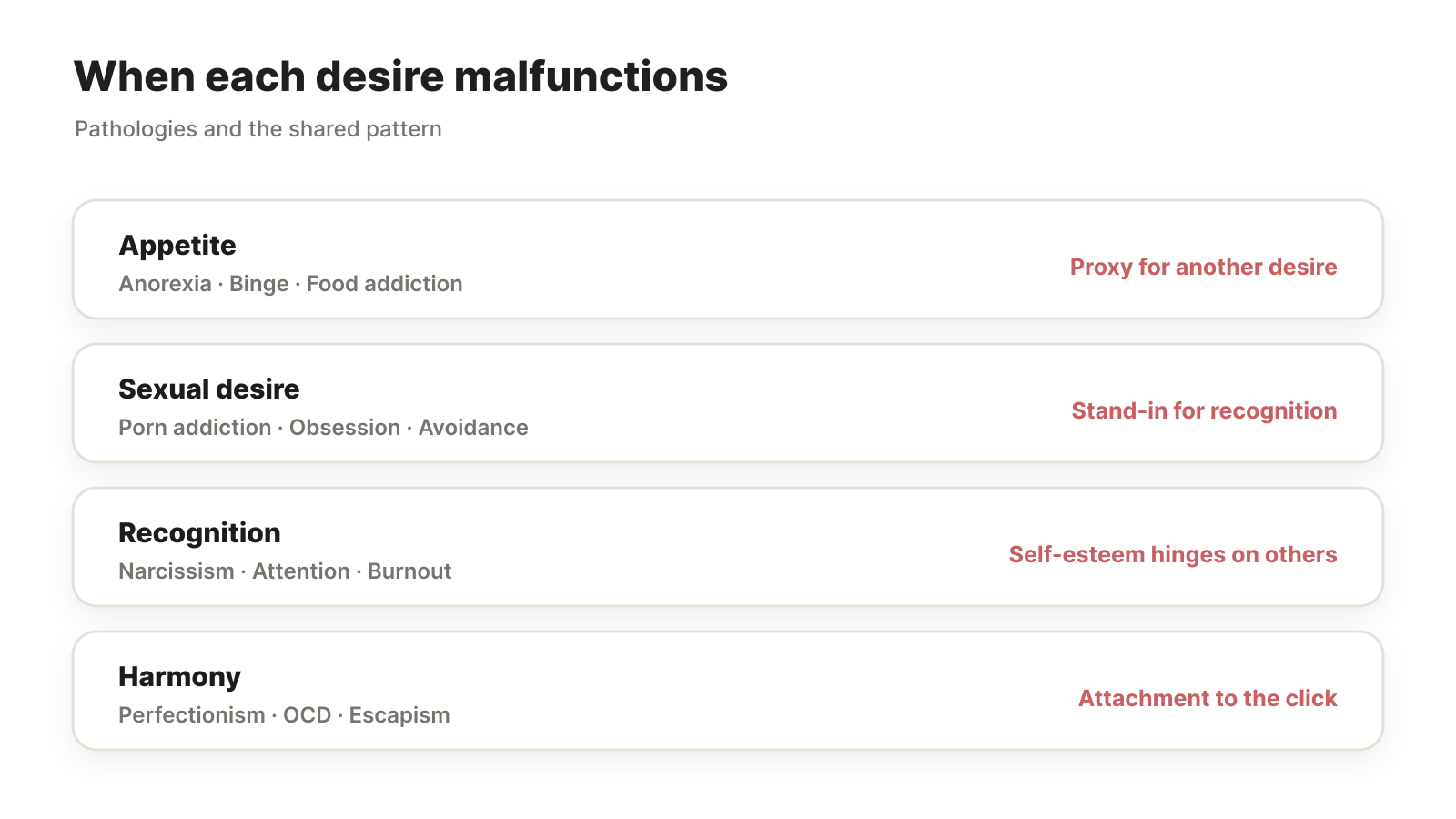
What happens when each desire malfunctions.
Appetite pathology: anorexia (a controlling drive overrides appetite), binge eating (appetite becomes an emotional-regulation tool), food addiction (chasing the stimulation itself). Shared pattern: appetite becomes a proxy for fulfilling some other desire.
Sexual desire pathology: porn addiction (looping stimulation without real connection), sexual obsession (recognition desire fuses too tightly with sexual desire), avoidance (fear of intimacy suppresses it). Shared pattern: sexual desire becomes a proxy war for recognition desire, or a pure stimulation loop.
Recognition desire pathology: narcissism (self-esteem fully subordinated to external validation), attention-seeking (chasing negative recognition when positive recognition is unavailable), self-hatred (a standard set so high it can never be met), burnout (running purely on recognition desire until other desires are depleted). Shared pattern: self-esteem becomes dependent on external recognition.
Harmony desire pathology: perfectionism (anything short of "click" is treated as nothing), obsessive-compulsive tendencies (a compulsive urge to preserve the "click" state), reality escape (immersing only in domains where harmony desire is easily satisfied, avoiding domains where recognition desire is required). Shared pattern: attachment to "click" interferes with adapting to reality.
The Relationship Between Recognition and Harmony Desire
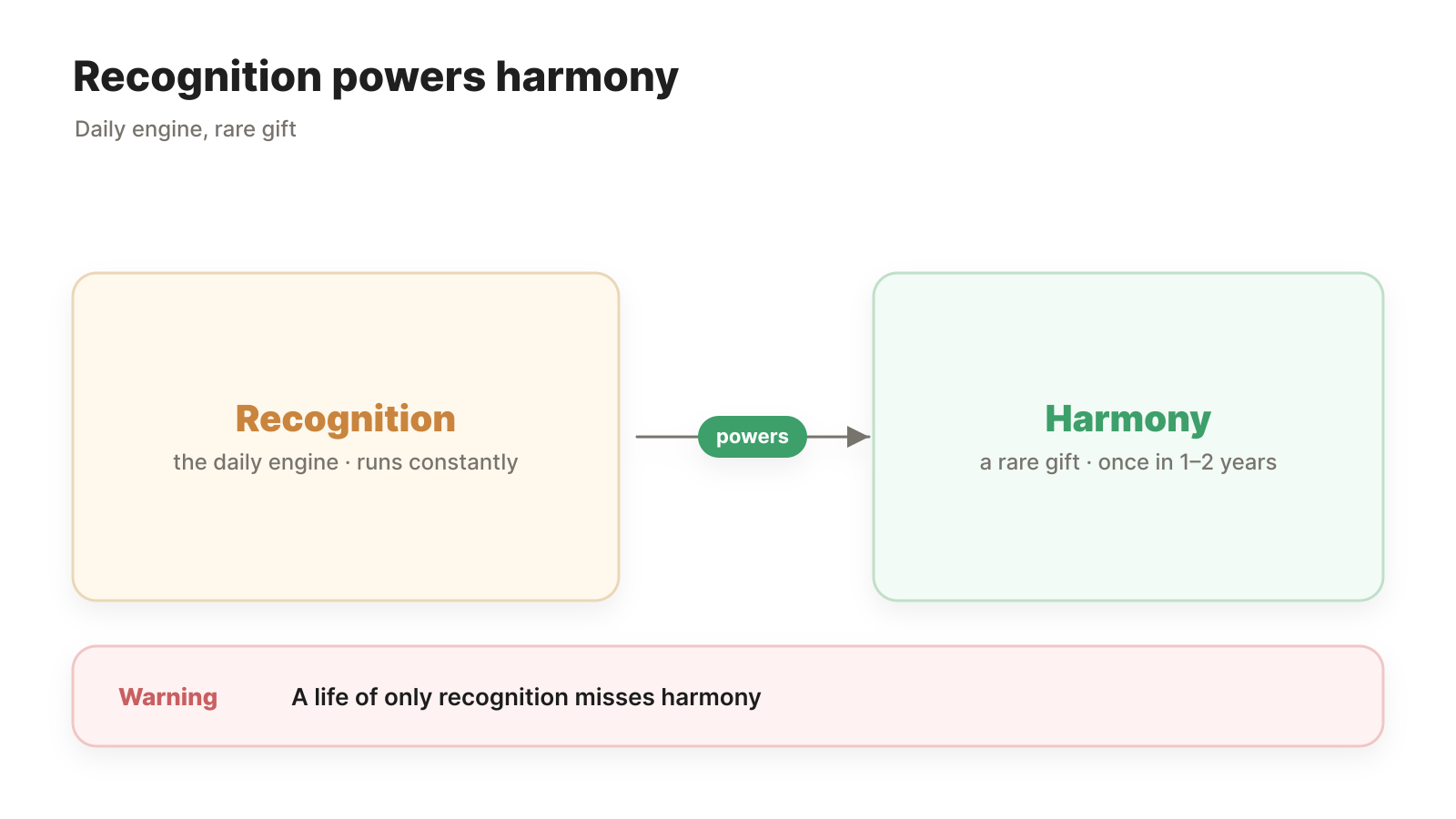
Recognition desire is the daily engine. Harmony desire is a gift that arrives once every year or two.
Without recognition desire, the chances of meeting harmony desire actually shrink — you need to keep digging into something for those moments to appear. There is no reason to make recognition desire a taboo.
The real danger is filling a life entirely with recognition desire and missing the moments of harmony desire in the process.
Limitations
This framework does not fully explain empathy or the desire for emotional connection. They may be an outward-facing version of recognition desire, but I am not certain yet. I leave that as an incomplete area.