Eric Ries · Reading log · October 16, 2026
Entrepreneurship is an experiment
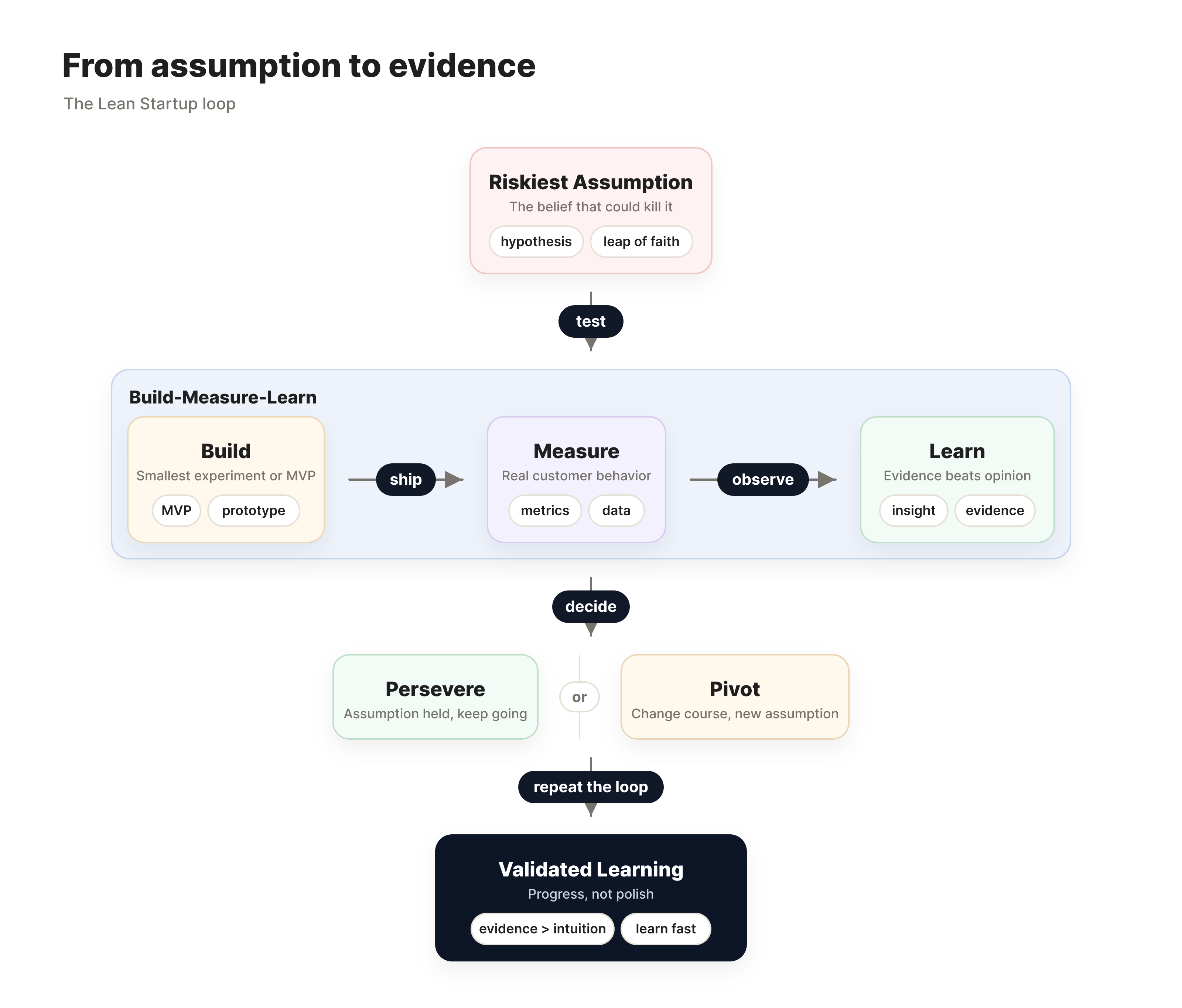
The Lean Startup explores how principles from Toyota's lean manufacturing system can be adapted to startups. What stayed with me was not simply the familiar Build–Measure–Learn loop. It was a deeper proposition: the job of a startup is to reduce uncertainty through evidence, not to execute a supposedly brilliant idea flawlessly.
Persuasive analogies are not proof
When company Y succeeds with factor X, it is tempting to believe that applying a similar X′ to company Y′ will reproduce the result. But outcomes depend on hidden conditions and interactions. Analogies are powerful when communicating unfamiliar ideas or inspiring a team; they are less trustworthy when substituted for testing. A story that persuades people is not necessarily a model that predicts reality.
Thousands of small decisions
Social networks existed before Facebook. Its eventual success cannot be explained by one brilliant idea alone. Product choices, distribution, user behavior, timing, and execution compound over thousands of decisions. If a great idea guaranteed success, the difficult steps after ideation would barely matter. We cannot know the future in advance; we can test what is true now.
Measure progress, not flattering numbers
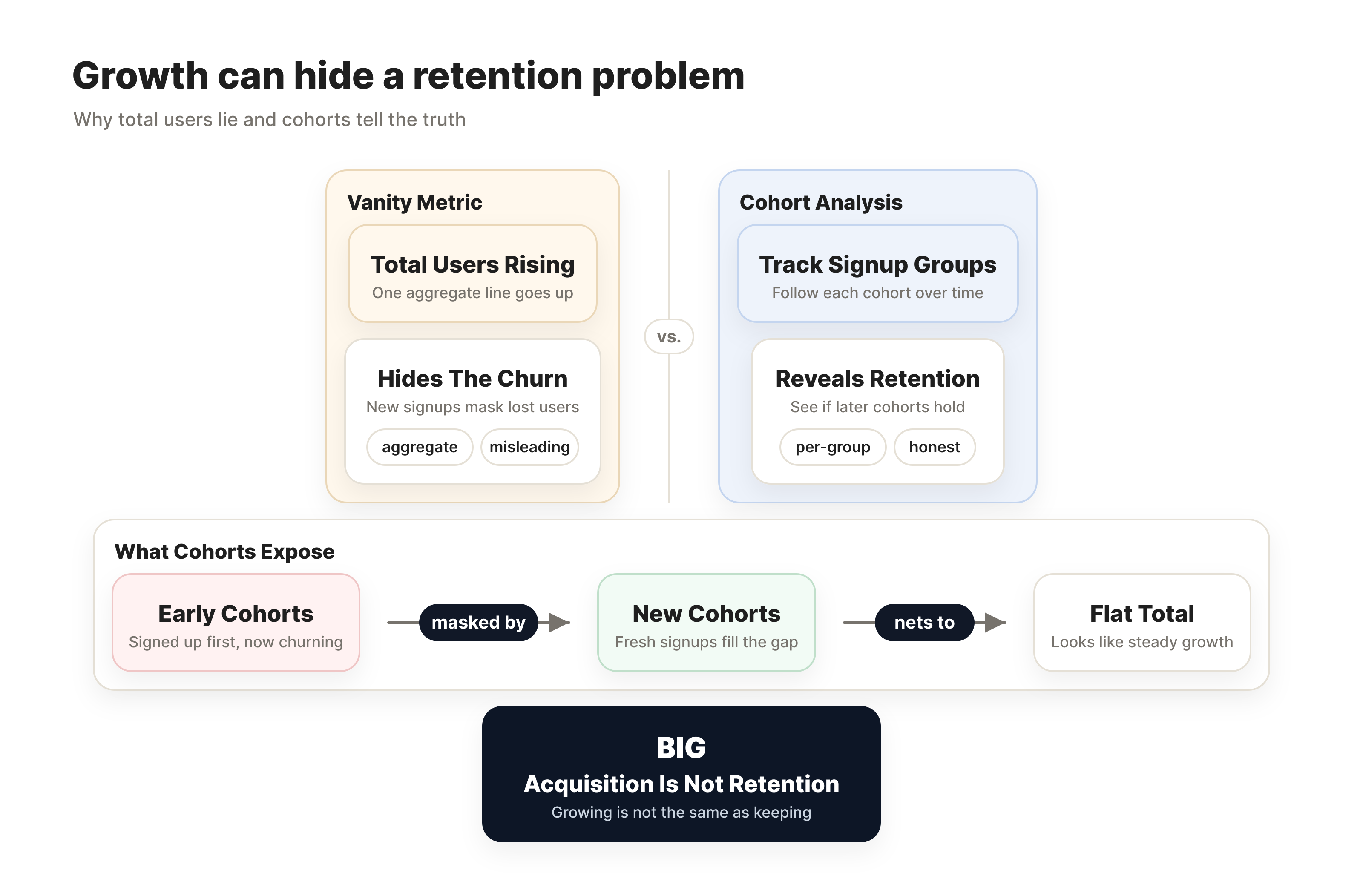
Traditional aggregate growth figures can make a startup look healthy while its underlying economics deteriorate. I want to pay closer attention to revenue per customer, acquisition cost, and retention—and to cohort analysis, which follows comparable groups of users through time. These are useful signals, not a complete accounting system. A rising user total means little if earlier users disappear as quickly as new ones arrive.
Build for users, not for the beauty of building
I admire Apple's obsessive attention to detail, but refinement can become waste when it solves the wrong problem. The book's IMVU story made this vivid: instead of spending heavily on realistic avatar walking animations, the team used teleportation—and users appreciated the speed. Early adopters may even fill in missing pieces with their imagination. A minimum viable product is not permission to be careless; it is a way to learn what deserves care. I also enjoyed the wonderfully named Wizard of Oz test, where people perform a process behind an apparently automated interface.
Why a startup can challenge a giant
While working at a modular housing startup, I wondered how a small company could possibly outrun established corporations. My answer was that startups can take asymmetric, high-risk bets and treat the real world as a laboratory. Reading Ries gave that intuition a more disciplined structure.
But experimentation has limits. First, founders worry that competitors will copy an unfinished product. That risk exists, yet I recognize my own tendency to exaggerate it. When launching Digging Music, I was self-conscious about exposing the idea; in retrospect, most people were probably not watching us that closely. The bigger risk may be building in private for customers who never arrive.
Second, experiments fail, and repeated failures can drain a team. I learned something about this from my former boss: he explained what improvement meant, set clear expectations, and noticed small details in our work. His attention made my contribution feel important. A leader must help people understand that a failed hypothesis can still be valuable learning, without pretending every failure is automatically worthwhile.
Third, the law sets real boundaries. In modular housing, I saw how government housing initiatives and discussions around special legislation could shape an emerging industry. My team leader participated in policy-related meetings; I was not deeply involved, but the experience changed how I saw regulation. Laws are not mathematics: they emerge from institutions, negotiations, and people. That makes them dynamic, not optional.
A company is a human system
The book also reminded me that systems thinking and understanding people belong together. Metrics change incentives; product decisions reflect human psychology; experiments require trust; leadership determines whether teams learn or merely feel judged. Entrepreneurship is not just engineering a product. It is coordinating a system of people, technology, and uncertainty.
My next experiments
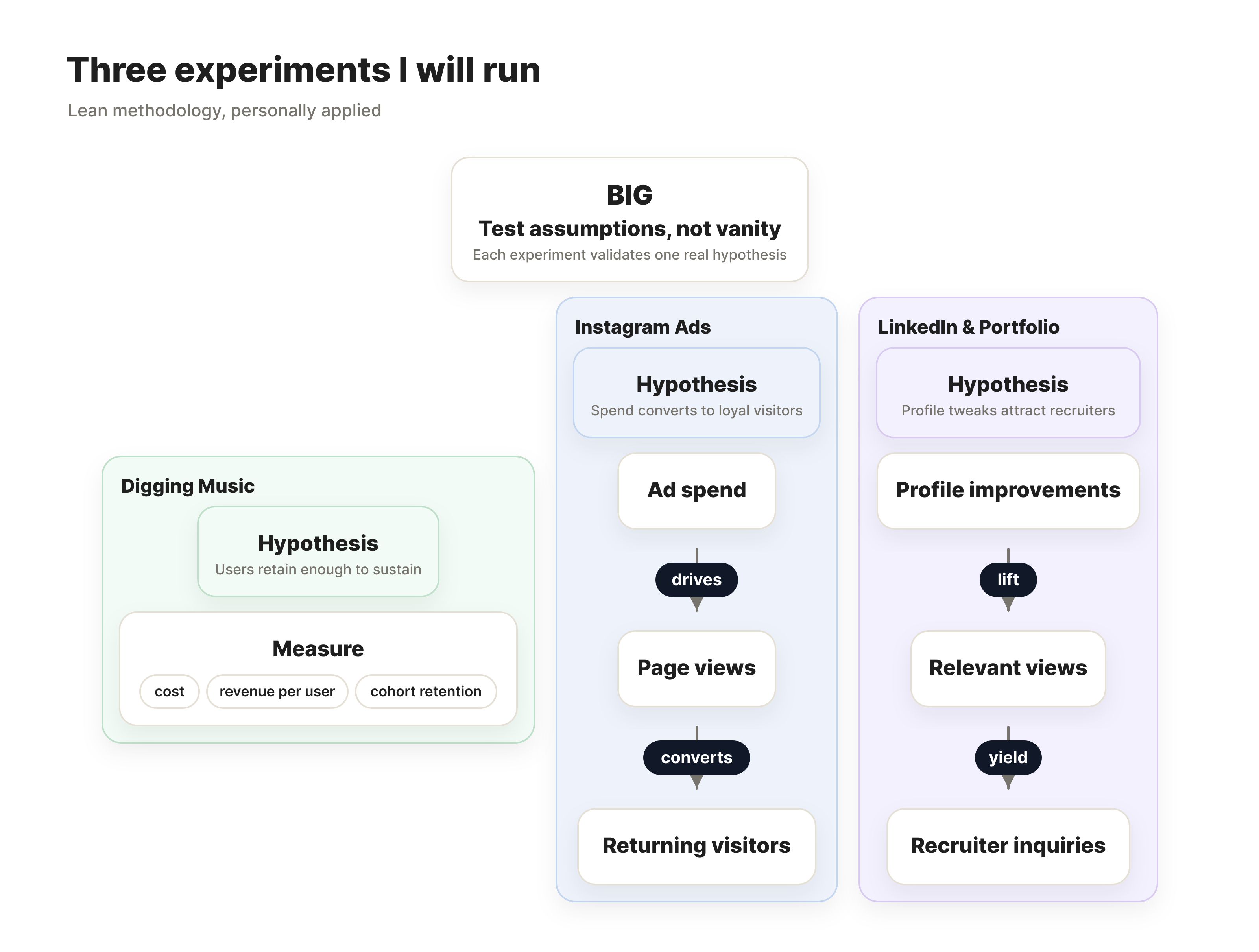
Digging Music: Audit operating costs, revenue per user, and cohort retention to understand whether the service creates lasting value. In the past, recruiting a small supporter group helped me uncover many bugs; now I want similarly direct feedback on retention and economics.
Instagram: Test whether advertising produces not just page views but engaged visitors who return. Traffic is a step, not the outcome.
LinkedIn and portfolio: Improve my professional presentation, then track relevant views, connections, recruiter inquiries, and eventually offers. The sample will be small and causality imperfect, but a measured experiment is still better than an unexamined assumption.
What I will remember
I came to this book believing startups could win by experimenting more boldly than large companies. I finished it thinking the real advantage is learning more honestly and systematically. Beautiful products, persuasive stories, and impressive charts can all conceal uncertainty. Progress begins when I stop asking “Should this work?” and start asking “What evidence would tell me whether it does?”