Why I Decided to Learn ABAQUS
I was curious about finite element analysis, or FEM.
My major is physics. In physics, many of the problems we study begin from idealized situations. They are usually designed to be analytically solvable, with conditions simplified enough for calculation. That kind of thinking is beautiful and powerful, but I felt that I needed a bridge toward handling more realistic problems.
That is why I decided to study numerical analysis, more specifically finite element analysis, and eventually ABAQUS as a practical tool for using it.
To be honest, I was not deeply attracted to numerical analysis or FEM itself. Once the theory gets mathematically intense, it starts to feel like the kind of mathematics I personally do not enjoy very much. So instead of trying to fully master the theory, I set my goal as learning ABAQUS as a tool for approaching real-world problems.
I chose ABAQUS for a few simple reasons. It is a professional engineering tool, it has a free student edition, and there was a book I could follow while studying.
How Modeling Works in ABAQUS
ABAQUS is broadly divided into Models and Analysis. The model types include general models, CFD models, and electromagnetic models. What I mainly studied was the general structural analysis model.
The modeling process can be roughly understood through five stages.
First, a basic 3D object is created in Part. Then, physical properties are defined in Material. Values such as Young's modulus, Poisson's ratio, and density belong here. After that, Section defines how the material is applied to the object. I understood it as the setting that determines whether the material is used as a line, surface, or solid structure.
ABAQUS also provides simple Features that can be directly created. Even complex shapes are ultimately built by combining these features.
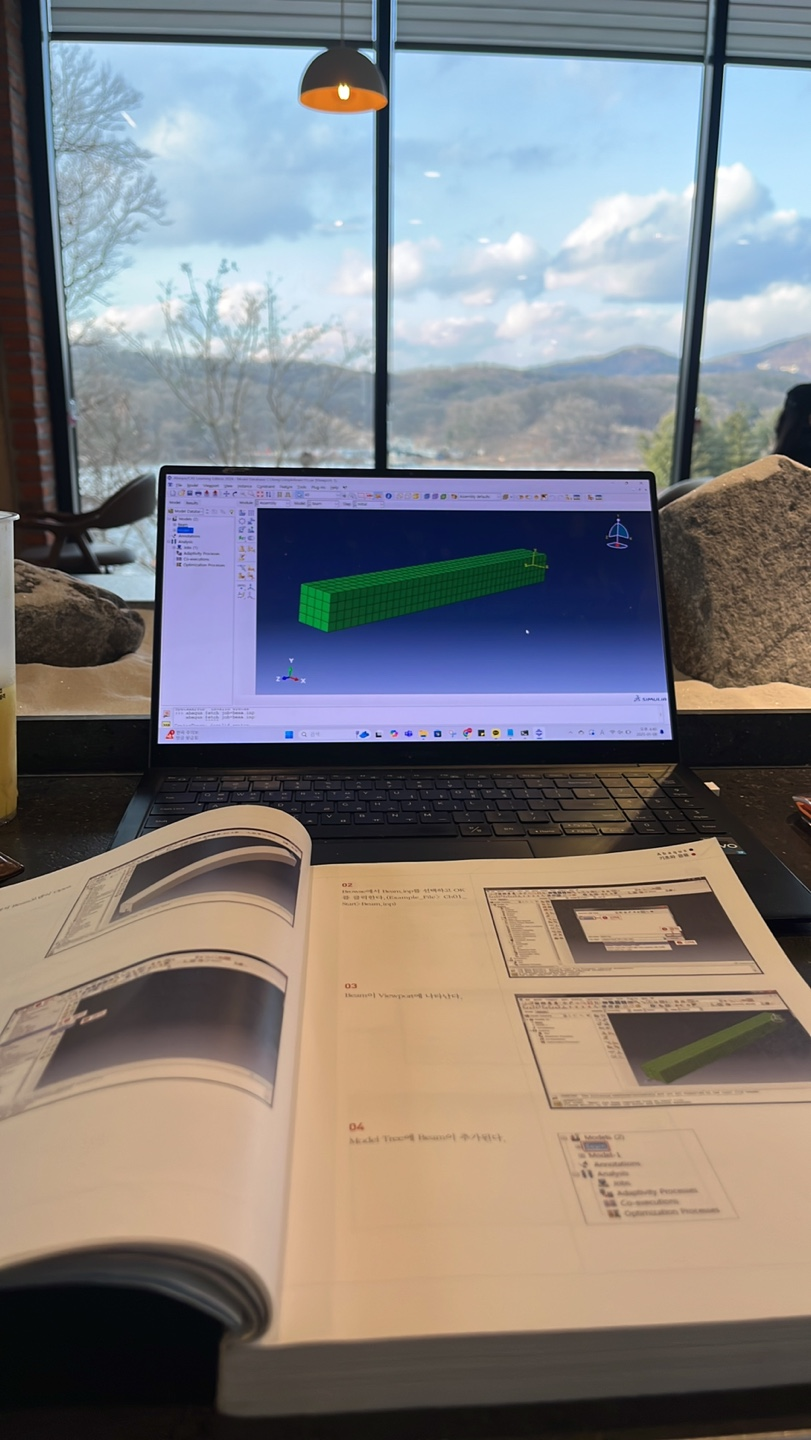
Then comes Mesh, one of the core processes of finite element analysis. It divides a large object into smaller elements. Simple shapes can be meshed at once, but more complex structures may need to be separated into multiple features or regions, meshed individually, and connected through constraints.
Assembly is the process of combining parts. Each part is placed into the actual analysis space, and the initial arrangement is determined. The copies of parts used in this stage are called Instances. If a part is like a blueprint, an instance is closer to the actual object placed inside the analysis space.
Step defines the sequence and time structure of the analysis. It includes initial conditions, time steps, and the type of analysis. The meaning of a step changes depending on whether the problem is static or time-dependent.
Interaction defines how instances interact with each other. For example, it determines whether two objects are in contact, whether friction exists, or whether they are tied together. I found it interesting that even something as obvious as "touching" in the real world has to be explicitly defined in a simulation.
Loads and Fields define external forces or fields applied to the model. Forces, pressure, gravity, temperature, and displacement conditions can all be included here. In the end, simulating a real-world problem means explicitly objectifying the shape, material properties, interactions, and external conditions of a system.
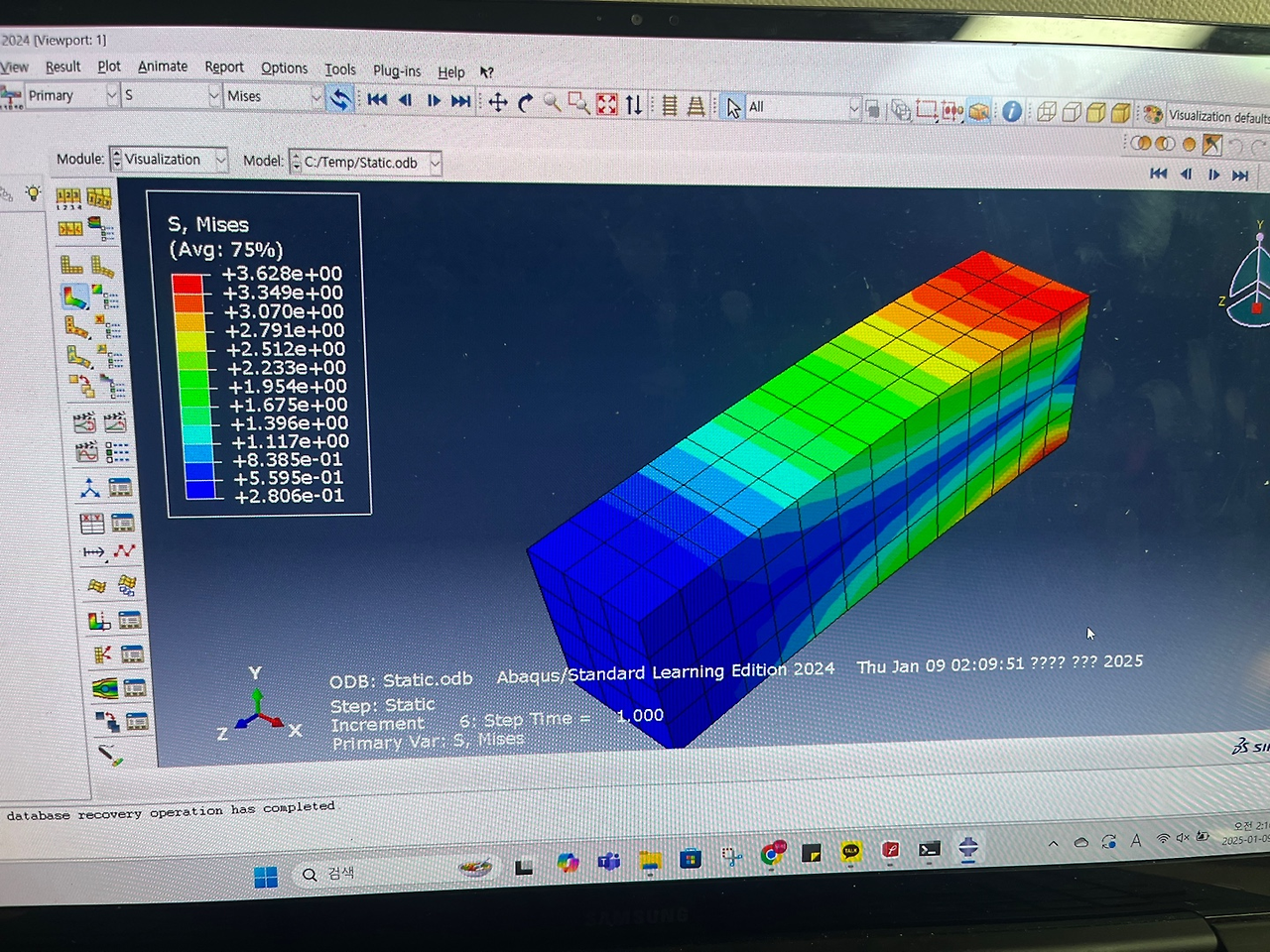
Once the model is complete, a Job is created and the simulation is run. After the calculation is finished, the results can be visualized to check stress, deformation, displacement, and other physical quantities.
What I Learned While Studying
The biggest thing I realized while studying ABAQUS was that simulation is not about putting reality directly into a computer.
Instead, it is about transforming a real-world problem into a computable structure. A physical object becomes a part. Its properties become materials. Its relationships become interactions. Its external conditions become loads.
In other words, a real-world problem is broken down into smaller components, each component is turned into an explicit object, and the whole system is reconstructed into a form that a computer can calculate.
The concept of mesh was especially interesting to me. Turning one continuous object into a collection of small elements is not just an engineering technique. It also felt like a useful model for thinking. Instead of trying to understand something complex all at once, you divide it into sufficiently small units and then define the relationships between them.
Another concept that stayed with me was the Eulerian formulation. In a typical approach, the mesh feels as if it deforms along with the object. In the Eulerian approach, the mesh in space remains fixed, while the properties of the material passing through that space change. I found it fascinating that the same problem can be modeled very differently depending on whether we focus on the object or on the space.
My Study Process
I studied by following examples from a book. However, the book was not structured in a way that first explained the concepts systematically and then moved on to examples. It felt closer to being thrown directly into examples. At first, I sometimes felt like I was just clicking buttons without fully understanding what I was doing.
Whenever that happened, I asked GPT questions and built the structure backward. I kept asking questions such as: "What does this step mean in the entire modeling process?", "What is the difference between Part and Instance?", "Why is Section necessary?", and "Why do we need to divide the object into a mesh?"
As I continued following the examples, the overall structure of ABAQUS slowly became clearer. At first, it looked like a collection of unfamiliar menus. Eventually, I began to see the flow of modeling.
Create a shape, define its material properties, assemble it, give it conditions, define interactions, apply forces, and run the calculation.
Toward the later part of the book, the examples started to feel repetitive. The electromagnetic section was not available in the educational edition, so I could not follow those examples directly. At that point, I felt that I was no longer gaining much new insight, so I mostly skimmed through the remaining examples to understand their general flow.
Reflections
The finite element analysis I learned is mostly calculated by the computer. Because of that, it feels a little strange to call it pure mathematics, pure science, or even just engineering.
Exaggerating a little, it almost felt like a practical technical trick.
But that was exactly what I liked about it.
To deal with real-world problems, these practical technical tricks are necessary. Solving an idealized physics problem and checking how an actual structure deforms, where stress concentrates, and under what conditions failure may occur are completely different things.
By studying ABAQUS, I feel like I built a small bridge between science and engineering.
Now, if I face a problem that requires simulation, I do not think I will be afraid of it. Instead of simply wondering, "How am I supposed to do this?", I now have a rough sense that I can approach the problem by breaking it down into shape, material properties, conditions, interactions, and mesh.
Finally, I gained several new cognitive models.
Personally, I think analogy is one of the best tools for understanding abstract things or generating new ideas. Concepts such as mesh, instance, interaction, and boundary condition are not only useful inside simulation software. They can also be used as metaphorical models for thinking about complex problems.
Break something complex into smaller parts, define the relationships, apply conditions, and observe the result.
That was the biggest thing I gained from studying ABAQUS.