From serving work to probability
I worked as a waiter at a restaurant for about four months.
Most of my shifts started around dinner time and continued until closing. The restaurant had a simple rule: closing work could only begin after every customer had left. Even if only one table remained, we could not start closing.
So a waiter's time was often literally waiting. That made me think about a small probability problem.
Suppose there are n tables. Let the time at which the customer at each table leaves be
If we assume these variables are independent, then the time at which closing can begin is not their average. It is the latest leaving time among them.
In other words,
Distribution of the maximum
To find the distribution of Y, we can look at the probability that Y is less than or equal to a certain time x.
This statement is intuitive: the maximum is less than or equal to x only when every table has left by time x.
Because the variables are independent, the joint probability becomes a product.
If each table follows the same distribution with cumulative distribution function F_X(x), then
That is the core result.
Normal-distribution example
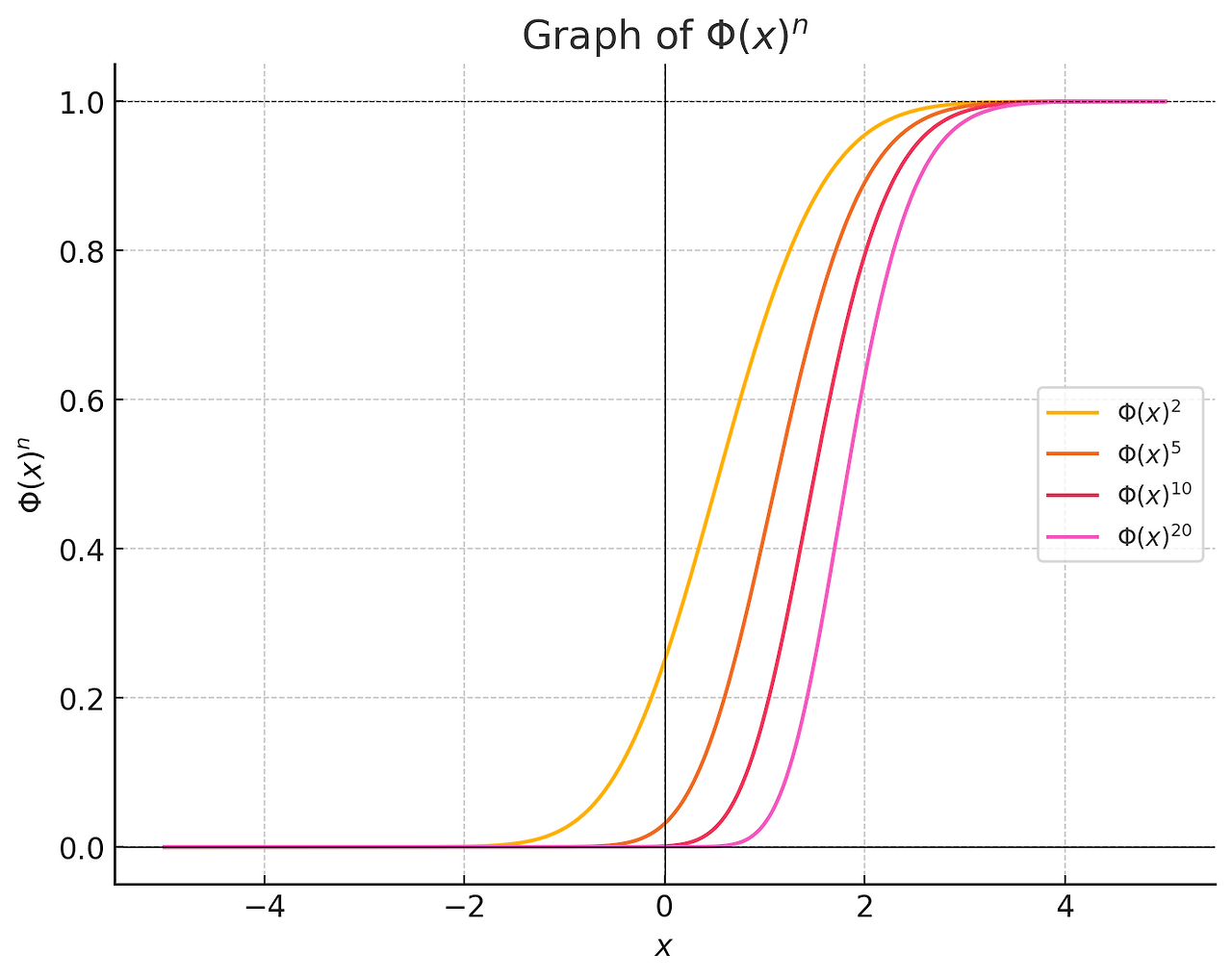
If we roughly assume that each table's leaving time follows a standard normal distribution, then
so the distribution of the latest leaving table becomes
As n increases, the graph shifts to the right. This means that the more tables there are, the lower the probability that all customers leave early.
The math matches the feeling from the floor: one extra table does not just add one more customer. It increases the chance that someone becomes the final table, and that final table controls when closing actually begins.